
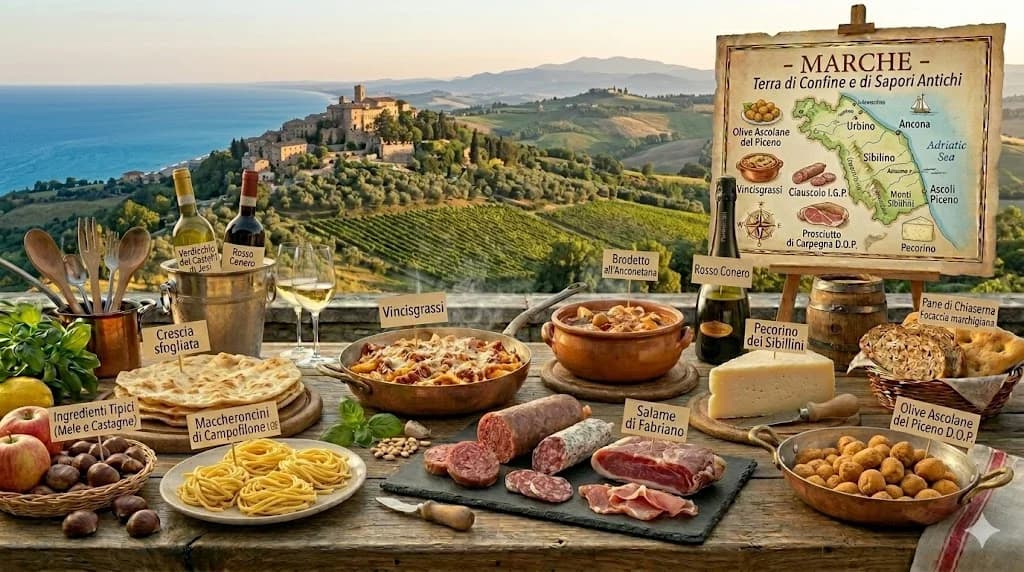
Marche
Cuisine of the Marche: authentic traditions, typical products and gastronomic identity
Introduction to the region
The Marche is a land that reveals itself slowly, just like its cuisine. From the shores of the Adriatic to the hilltop villages of the interior, every corner tells a story made of seasons, agricultural work and conviviality.
Here gastronomy is never spectacle, but substance: it is born in family kitchens, passed down at village festivities and expressed through dishes that privilege balance and recognizability of flavors. It is a profoundly territorial cuisine, where sea and mountain dialogue without ever overlapping, giving life to one of Italy's most authentic culinary traditions.
Characteristics of Marchigian cuisine
A natural balance between sea and land
The strength of Marchigian cuisine lies in its dual soul:
The Adriatic coast offers an essential fish cuisine rich in nuances, made of brodetti, soups and grilled preparations
The hilly and mountainous interior preserves a robust tradition, based on meat, cured meats, legumes and fresh pasta
This balance translates into varied cuisine, never redundant, where each ingredient has a precise role.
Distinctive ingredients and techniques
Complete working of pork, the heart of local charcuterie
Widespread use of wild fennel, garlic and rosemary
Handmade pasta, rolled with a rolling pin and often very thin
Slow and stratified cooking, especially in sauces
Tradition of resourcefulness, with valorization of bread, broths and less noble cuts
Typical products of the Marche
The gastronomic heritage of the Marche is distinguished by authenticity and strong connection to the territory.
Signature products
Oliva Ascolana del Piceno
Born in aristocratic kitchens and become a symbol of local street food, it combines external crispiness and flavorful filling.Ciauscolo
Fresh and spreadable cured meat, with spiced aroma and creamy consistency, typical of the provinces of Macerata and Ascoli Piceno.Prosciutto di Carpegna
Characterized by delicate sweetness and aging influenced by the microclimate of Montefeltro.Casciotta d'Urbino
Soft and slightly aromatic cheese, already known at the court of the Dukes of Urbino.Maccheroncini di Campofilone
Very thin pasta threads, symbol of a craftsmanship passed down and still alive.
Other relevant products
Black truffle of the Sibillini Mountains
Lentils and legumes of the Apennines
Artisanal hill honey
Pecorini and pit-aged cheeses
Traditional Marchigian dishes
The cuisine of the Marche expresses itself best in traditional dishes, often linked to festivities and family conviviality.
First courses
Vincisgrassi
An emblematic dish of the region, it stands out from lasagne for a more complex ragù, enriched with offal and a more intense structure.Passatelli in brodo
Rustic and fragrant, widespread especially in the north of the region.Maccheroncini di Campofilone
Served with rich meat sauces, protagonists of festive tables.
Main courses
Coniglio in porchetta
Aromatized with wild fennel, it represents the essence of Marchigian peasant cuisine.Mixed grilled meats
Cuts of local meat cooked over charcoal, often accompanied by bread and red wine.
Seafood dishes
Brodetto marchigiano
An identity-defining preparation with numerous local variants:Ancona: with tomato and a note of acidity
Fano: more essential, without tomato
San Benedetto del Tronto: rich, with wide variety of fish
Stoccafisso all'anconetana
Long preparation process and decisive flavor, symbol of maritime tradition.
Baked goods
Crescia sfogliata
Rich and stratified, more structured than piadina, perfect with local cured meats.Pizza al formaggio
Typical of the Easter period, soft and intensely aromatic.
Wines and typical beverages of the Marche
The winemaking panorama of the Marche is refined and deeply tied to the territory.
White wines
Verdicchio dei Castelli di Jesi
Fresh and mineral, with a typical final note of almond, capable of evolving over time.Verdicchio di Matelica
More structured, with greater aromatic complexity.
Red wines
Rosso Conero
Intense and spiced, ideal with roasted meats and structured dishes.Lacrima di Morro d'Alba
Extremely aromatic, with distinctive floral notes.
Winemaking traditions
Vernaccia di Serrapetrona DOCG
Red sparkling wine obtained with a unique technique.Vino cotto
Expression of peasant culture, dense and enveloping.
Gastronomic production areas
The Marchigian territory is fragmented into areas with precise identities:
Ascoli Piceno: Oliva Ascolana, fried foods, popular tradition
Jesi and Ancona: Verdicchio and maritime cuisine
Macerata: cured meats and egg pasta
Urbino and Montefeltro: cheeses, truffles and livestock raising
San Benedetto del Tronto: fish culture and brodetto
Traditions, festivals and gastronomic events
In the Marche, food is also an occasion for meeting and collective identity:
Festival of the Oliva Ascolana
Verdicchio Festival
Truffle festivals in the interior
Seasonal events linked to harvests and vintages
Participating in these events means entering the authentic heart of local culture.
Curiosities about Marchigian cuisine
Vincisgrassi have complex historical origins, probably linked to the Napoleonic era
Brodetto changes recipe along the entire coast, making each version unique
Ciauscolo is consumed fresh, without long aging
Many dishes are born from recovery cuisine, today revalued in a gastronomic key
Certified products DOP, IGP and DOC/DOCG wines
DOP
Prosciutto di Carpegna DOP
Casciotta d'Urbino DOP
Oliva Ascolana del Piceno DOP
IGP
Ciauscolo IGP
Maccheroncini di Campofilone IGP
DOC and DOCG
Verdicchio dei Castelli di Jesi DOC / DOCG
Verdicchio di Matelica DOC / DOCG
Rosso Conero DOC
Lacrima di Morro d'Alba DOC
Vernaccia di Serrapetrona DOCG
Tips for best tasting the Marche
To truly understand this cuisine:
Sit in a traditional trattoria in the interior and follow the daily specials
Taste the same dish in different areas (such as brodetto)
Always pair local wines with traditional dishes
Buy products directly from small producers
Deepen recipes to grasp their cultural value
Conclusion
The cuisine of the Marche does not seek to amaze, but to tell stories. It is made of ancient gestures, recognizable ingredients and flavors that do not need to be reinterpreted to be current.
Discovering it means slowing down, traversing diverse territories and letting yourself be guided by a tradition that has managed to evolve without losing authenticity. In every Marchigian dish there is a fragment of local history, a bond with the land and a silent invitation to return