
Guide·Sagre·Fiere·Mercati·Degustazioni
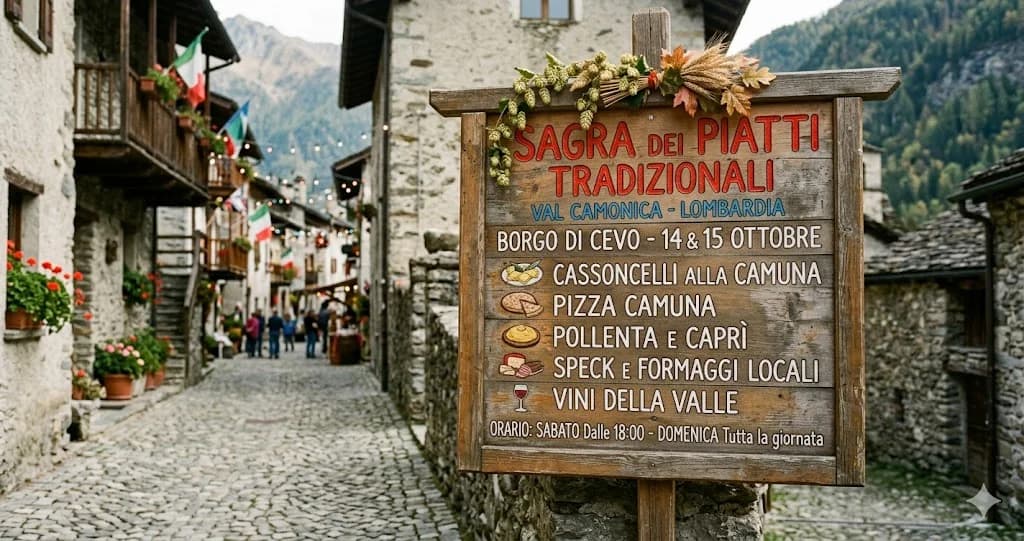
In the valleys rising from the plains towards the Alps and Lombard Prealps, and on the shores of the great lakes, every year a calendar of food festivals repeats itself, telling the story of a lesser-known Lombardy: not that of the major cities, but that of the villages where cuisine is still tied to the cycle of seasons, to hunting, to alpine pasturing and lake fishing. This guide takes the reader through the most deep-rooted food festivals of the mountainous and lake region, from Valtellina to Lake Como, from Lake Iseo to the valleys of Bergamo and Brescia, offering concrete tools to navigate, choose and experience these occasions with awareness.
Mountain and lake Lombardy has a large number of festivals that escape the most beaten tourist circuits. These are mostly events organized by local tourism boards, volunteer associations and parish communities, often linked to a specific product: the pizzocchero di Teglio, the Bresaola della Valtellina, the missultin of Lake Como, the tench of Lake Iseo, the formaggella della Val Camonica, the honey from the Bergamo valleys. These festivals are not born as attractions: they are born as community practices, ways to celebrate the end of the agricultural season or the alpine pasture season, to sell productive surplus, to come together.
The heritage of flavors they preserve is protected in part by DOP and IGP marks, in part by Slow Food presidia, but in most cases it survives thanks to the informal transmission of knowledge between generations. The demographic crisis in mountain areas and the abandonment of some traditional agricultural practices make these festivals not only occasions for celebration, but also moments in which a fragile food system becomes visible and defends its own continuity. Participating also means supporting local economies that depend on a demand for quality that is difficult to find elsewhere.
January and February The winter months are sparse in outdoor festivals, but the Alpine valleys host indoor markets and fairs dedicated to aged cheeses, mountain cured meats and honey. In Valtellina, some municipalities organize evenings of bresaola and local red wine in historic cellars. It is the right time to visit the mountain dairies that open to the public during the cold season for direct sales of cheeses and bitto.
March and April With the thaw, the first seasonal events resume. The Bergamo and Brescia valleys host spring fairs linked to cheese-making: milk returns to the mountain pastures and communities celebrate the beginning of a cycle. On Lake Iseo, the first festivals linked to tench fishing begin, a fish that is the protagonist of Brescia lake cuisine.
May May marks the true opening of the festival calendar. In Val Camonica and Valchiavenna, the first festivals of fresh cheeses and dairy products from mountain dairies are held. On Lake Como, in May, some lakeside communities celebrate traditional fishing with tastings of missultin and dried agoni.
June and July These are the most intense months. The pizzocchero festival of Teglio, in Valtellina, is one of the most anticipated events of the season, with collective outdoor preparations of the dish. The Bergamo valleys organize festivals dedicated to formai de Mut and mountain pasture cheeses. On Lake Garda, on the Lombard side, lake fish festivals are held with carpioni and eels as protagonists.
August The peak month for village festivals. Almost every mountain and lakeside municipality offers at least one event. In Alta Valtellina, bresaola culture is celebrated with tastings paired with Sassella and Inferno wines. In Val Brembana and Val Seriana, cheese festivals are organized with local alpine herders and cheese makers.
September and October Autumn brings festivals dedicated to porcini mushrooms, forest fruits and game. In Val Camonica and the Brescia valleys, polenta festivals are held, often accompanied by local game. October is the month of chestnuts: Valle Imagna and Valle Brembana offer events dedicated to the harvest and processing of the fruit, with roasted chestnuts and chestnut flour as protagonists.
November and December The year's final festivals revolve around preserved products: cured meats, long-aged cheeses, honey and grappa. Some lakeside communities organize tastings of smoked and carpione fish. With the arrival of Advent, Christmas markets in the alpine valleys further enhance the gastronomic offering, with chestnuts, mulled wine made with local wines and traditional Valtellina sweets such as bisciola.
The food festivals of Lombardy's mountain valleys and lakeside areas are not a spectacle to observe from the outside. They are the moment when a community decides to make visible what it produces, to open its cellars and kitchens to those coming from elsewhere. The best way to experience them is to slow down: stop at a single stand, ask questions of the cheesemaker, understand how the cheese is made before buying it. An afternoon spent this way gives more than an organized gastronomic tour. Take home a product, yes, but above all take home the name of the producer.