
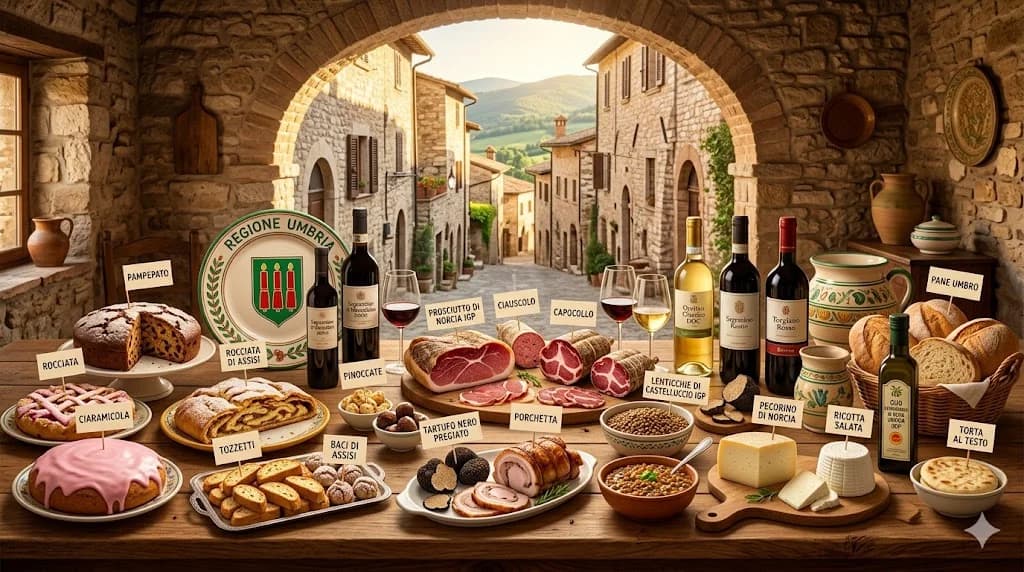
Umbria
Umbria: the cuisine of Italy's green heart between peasant memory, monastic identity and essential flavors
1. Introduction to the region
Umbria is not merely crossed: it is listened to. It is a region without a sea and without major coastal cities, but with a landscape that seems built to preserve memory. Ordered hills, deep valleys, stone villages and agricultural silences define a space where cuisine has never been an industry, but a form of cultural continuity.
Here food arises from an ancient necessity: to preserve, nourish, valorize what the earth grants without waste. This is why Umbrian gastronomic tradition is one of the most coherent in Italy. It has not evolved through ruptures, but through slow stratification, between peasant culture, Etruscan-Roman heritage and medieval monastic discipline.
Umbria is, in this sense, a cuisine of balance: few raw materials, chosen with rigor, transformed with respect.
2. The deep structure of Umbrian cuisine
No Umbrian cuisine exists without one key word: essentiality. But essential does not mean poor. It means precise.
The regional cuisine rests on a few supporting axes:
pork and the Norcia tradition as a technique of survival and food culture
cereals and legumes as historical energy base
the olive tree as the identifying plant of the landscape
black truffle as an element of natural prestige
game as the heritage of Apennine areas
sheep's milk cheeses as the synthesis of local pastoralism
This structure arises from a simple economic history: Umbria was for centuries an agriculturally self-sufficient region, where every family produced, preserved and transformed.
The result is not a "poor" cuisine, but a cuisine of material truth: nothing is decorative, everything has a function.
3. Products: when territory becomes identity
In Umbria the product is never merely an ingredient. It is transformed landscape.
The certified supporting pillars
Extra Virgin Olive Oil Umbria DOP
It is the most transversal element of regional cuisine. It does not accompany: it defines. Its herbaceous and bitter notes tell the geography of the hills better than any description.Farro di Monteleone di Spoleto DOP
It is not a "recovered" cereal, but a cereal that never truly disappeared. It survives where the earth does not grant abundance, but returns quality.Lenticchia di Castelluccio di Norcia IGP
Small, resistant, concrete. Its strength is adaptation: it grows where others cannot.Prosciutto di Norcia IGP
Here the processing of pork becomes a cultural language. There is no waste, there is transformation.
The uncertified signature product
Black truffle from Norcia and Spoleto
It has no need of marks to be recognized. It is an aroma before it is an ingredient: it enters dishes without dominating them, but modifying their perception.
4. The dishes: cuisine as a form of memory
Umbrian dishes are not complex gastronomic constructions. They are historical equilibria between what one had and what one could do.
The first courses
Strangozzi al tartufo
It is one of the few Italian dishes in which the structure is almost invisible. The pasta exists to sustain the aroma, not to be the protagonist.Pappardelle al cinghiale
Born from hunting and the need to preserve meat, today it remains a dish of direct intensity, without mediation.Zuppa di farro
It is the most ancient form of domestic cooking: a single pot, long times, an essential result.
The main courses
Porchetta umbra
It is not just a festive dish. It is a cooking technique that spans centuries, conceived to transform an entire animal into a preservable and shareable food.Agnello alla scottadito
Fegatelli umbri
Selvaggina in umido
These dishes have no need for elaborate presentation: they belong to a cuisine that does not explain itself, it is recognized.
5. Wine: balance between strength and measure
Umbrian viticulture is not extensive, but it is precise. Every wine is tied to a zone, and every zone to a character.
Sagrantino di Montefalco DOCG
It is a wine that does not seek immediate consensus. It requires time, like many Umbrian things. Its identity lies in structure more than in accessibility.Montefalco Rosso DOC
It is the more engaging version of the territory: less extreme, but coherent.Orvieto DOC
A white wine that tells an ancient continuity, linked to one of the most stratified cities in the region.
6. Geographies of Umbrian taste
Umbria does not have a single cuisine. It has coherent micro-identities.
Norcia and Valnerina: culture of preservation, pork butchering, black truffle
Montefalco: wine intensity and hillside agriculture
Castelluccio: extreme agriculture and high-altitude legumes
Orvieto: Etruscan heritage and historic white wines
Umbrian Apennines: rustic cuisine, game, pastoral tradition
The cuisine changes slowly, but it changes. Always in relation to the land.
7. Traditions and social time of food
In Umbria food is never separated from the calendar of communities. Festivals are not tourist events created for attraction: they are the contemporary form of an ancient sociality.
Black Truffle Festival of Norcia
Lenticchia di Castelluccio Festival
Eurochocolate in Perugia
Open Cellars
Village festivals dedicated to porchetta, game and local products
These moments do not celebrate only food, but the continuity between production and collective identity.
8. A cuisine that does not seek effects
Umbrian cuisine does not work on impact. It works on coherence.
There are no dominant spectacular techniques, nor gastronomic constructions conceived to astonish. There exists instead a profound trust in raw materials and time.
It is a cuisine one rarely forgets, precisely because it never attempts to impress.
9. How to truly read Umbrian cuisine
To understand Umbrian gastronomy it is not enough to taste. One must observe three elements together:
the landscape, which determines what can be cultivated
history, which imposed preservation and measure
community, which transformed food into daily ritual
Only from this overlap is the meaning of its cuisine born.
Editorial closing
Umbria is a region that has no need to be reinterpreted. It needs to be listened to. Its cuisine does not update: it is recognized. And precisely for this reason, it remains one of the most integral expressions of Italian gastronomic culture.