
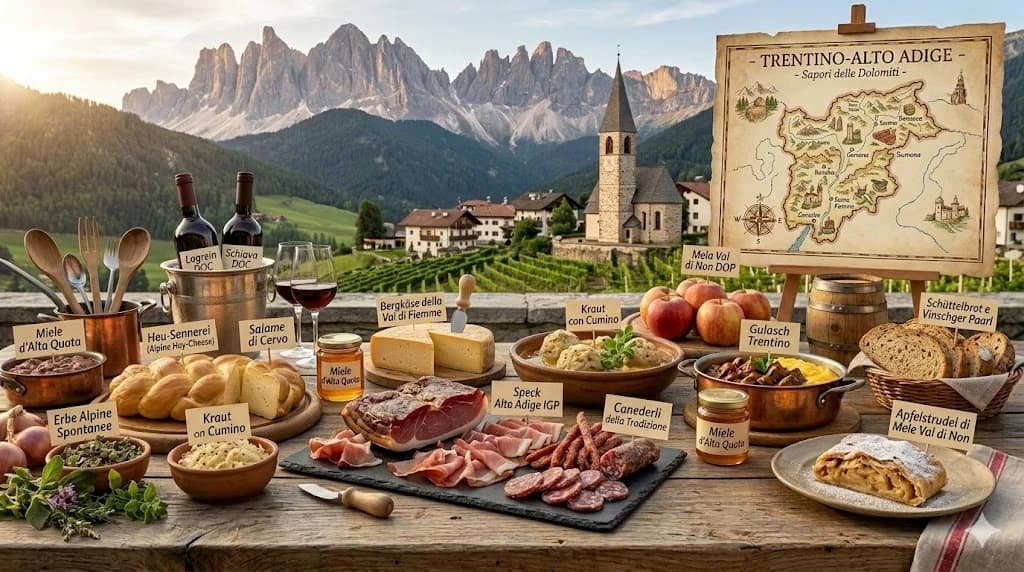
Trentino Alto Adige
Trentino Alto Adige: the ultimate gastronomic guide
Local products, alpine cuisine, traditions and recipes
Introduction: where the mountain becomes food culture
Trentino Alto Adige is one of Italy's most distinctive territories from a gastronomic point of view. Here, cuisine arises from a direct relationship with the mountains: harsh climate, marked seasons, and the necessity to preserve and enhance every resource.
The cuisine of Trentino and Alto Adige is the result of centuries of exchange between the Italian and Central European worlds. This produces a concrete, essential gastronomy, yet surprisingly refined in the quality of raw materials and the precision of techniques.
Speaking of typical products of Trentino Alto Adige means telling the story of alpine pastures, grazing lands, mountain cellars and traditions still alive in small communities.
Identity of Trentino and Alto Adige cuisine
The regional cuisine is based on key principles:
strong connection to seasonality and alpine territory
use of traditional preservation techniques such as smoking and drying
centrality of bread, pork, milk and potatoes
balance between rural simplicity and Central European precision
complete valorization of raw materials, without waste
In Alto Adige, a stronger Tyrolean influence is perceptible, with structured dishes and decisive flavors. In Trentino, the cuisine maintains a more Italian character, while remaining deeply alpine.
Typical products of Trentino Alto Adige
DOP, IGP and certified products
Speck Alto Adige IGP is the symbol of the region. It is produced from the pork thigh, salted and spiced with juniper, pepper and bay leaf. It undergoes light cold smoking and long aging in an alpine environment. Quality can be recognized in the cut: thin slice, vivid red color with compact fat portion, balanced aroma between smoked and spiced. Traditionally it is served with a knife, never too cold, to enhance its aromas.
Mela Alto Adige IGP grows in a unique setting characterized by temperature variations and clean air. The main varieties offer crispness, acidity and clear aromas, ideal for both fresh consumption and pastry making.
Trentingrana DOP is a long-aged cheese produced with mountain milk. Compared to other grana cheeses, it presents greater aromaticity linked to cattle feed.
Spressa delle Giudicarie DOP is a historic Trentino cheese, born as a "recovery" product after butter production. It has a decided taste, slightly tart and compact structure.
Cured meats, bread and identity products
Alongside speck, Kaminwurzen represent one of the most authentic cured meats. They are small smoked and dried sausages, ideal for mountain consumption, often accompanied by rye bread.
Schüttelbrot is the crispy South Tyrolean bread, made with rye flour and spices. It was born as a long-keeping food and still today accompanies cured meats and cheeses.
Luganega trentina is an aromatic fresh sausage, used both grilled and in traditional preparations.
Mountain pasture cheeses, produced during alpine grazing season, represent the highest expression of alpine seasonality. Each alpine hut produces cheeses with unique characteristics, linked to the pastures.
Natural and mountain products
Small forest fruits such as blueberries, raspberries and currants are the basis of desserts and preserves.
Dolomite mushrooms, particularly porcini and chanterelles, are protagonists of autumn cuisine.
Alpine herbs are used both in cooking and in the production of digestive liqueurs.
Alpine pasture butter is rich, aromatic and fundamental in traditional preparations.
Traditional dishes of Trentino Alto Adige
Canederli represent the heart of alpine cuisine. They arise as a dish to use stale bread and come in numerous variants, from speck to cheese to sweet versions.
Spätzle are soft dumplings of Germanic origin, often prepared with spinach and dressed with melted butter.
Tyrolean gulasch is a slow preparation, rich in spices, perfect for cold climates.
Polenta di Storo accompanies meats, cheeses and game and is one of the most rooted elements in Trentino cuisine.
Barley soup is a nourishing dish and represents the peasant tradition of the valleys.
Ribs with sauerkraut reflect the Austro-Tyrolean influence, with decided and fermented flavors.
Apple strudel is the dessert symbol of the region, where thin pastry encloses a fragrant filling.
Ladin dishes such as cajinci and tutres tell of an even more local cuisine, linked to the Dolomite valleys.
Wines and typical beverages
Trentino Alto Adige is one of the most important wine territories in Italy.
Among whites stand out Gewürztraminer, Müller-Thurgau and Pinot Bianco, characterized by freshness and aromatic precision.
Among reds stand out Lagrein, Teroldego and Schiava, each with characteristics linked to the territory.
Trentino grappa is one of the excellences of Italian distillation.
Alpine herb liqueurs are born from traditional recipes passed down over time.
Production areas and territorial identity
Val di Non is the center of apple production.
Piana Rotaliana is the territory of Teroldego.
Alto Adige is one of the most suited wine areas in Europe.
The Dolomites host alpine huts and cheese production.
Ladin valleys preserve authentic cuisine less influenced by tourism.
Gastronomic traditions and experiences
Törggelen is an autumn tradition in which new wine, speck, canederli and chestnuts are tasted in stubes. It is one of the most authentic moments of local gastronomic life.
Open alpine huts allow you to witness cheese production and taste it directly at altitude.
Village festivals represent the real cuisine of the territory, far from tourist versions.
Christmas markets unite gastronomy and culture, enhancing local products.
Curiosities about local cuisine
The cuisine of Trentino Alto Adige is one of the most influenced by Central European culture in Italy.
Smoking is a fundamental technique in meat preservation.
Rye bread has been an essential food for the alpine population for centuries.
The apple is one of the products symbolizing the regional economy.
The contrast between sweet and salty is a constant in tradition.
Tips for tasting at your best
To truly discover the typical products of Trentino Alto Adige, it is important to move away from the most touristy routes.
Alpine huts offer the most authentic products during summer.
Traditional stubes allow you to experience cuisine in its original context.
Local cellars represent a reference point for wine quality.
Following seasonality allows you to grasp the essence of alpine gastronomy.
Traditional recipes
Canederli with speck
Ingredients
stale bread
speck
eggs
milk
flour
chives
salt and pepper
Preparation
The bread must be stale but not dry. It should be softened with milk without making it too wet. Finely cut speck, eggs and aromas are added. The dough must be compact but soft.
The key step is the formation: the spheres must be well pressed to prevent them from breaking during cooking. They are cooked in hot broth without strong boiling.
Common mistake to avoid: dough that is too soft or broth that is boiling.
Spätzle with spinach
Ingredients
flour
eggs
spinach
water
salt
Preparation
The spinach must be well squeezed and finely chopped. The dough must be soft but not liquid.
A special tool is used or they are dropped into water with a knife.
They are ready when they rise to the surface.
Trick: dress them immediately with hot butter to keep them soft.
Apple strudel
Ingredients
apples
thin pastry
raisins
pine nuts
cinnamon
sugar
Preparation
The pastry must be very thin, almost transparent. The apples should be cut uniformly to ensure even cooking.
The filling must be balanced between sweetness and acidity.
Mistake to avoid: excess liquid that makes the base wet.
Conclusion
Trentino Alto Adige represents one of the most authentic expressions of Italian gastronomy. Its strength does not lie in apparent complexity, but in the coherence between territory, products and tradition.
The cuisine of Trentino and Alto Adige is still today tied to the real life of people, to the seasons and to the mountains. From cured meats to cheeses, from wines to traditional recipes, each element contributes to defining a solid, recognizable and deeply authentic gastronomic identity.
Whoever wants to truly understand what to eat in Trentino Alto Adige must start from here: from the products, from the alpine huts and from the simple tables that tell of a food culture still alive.