
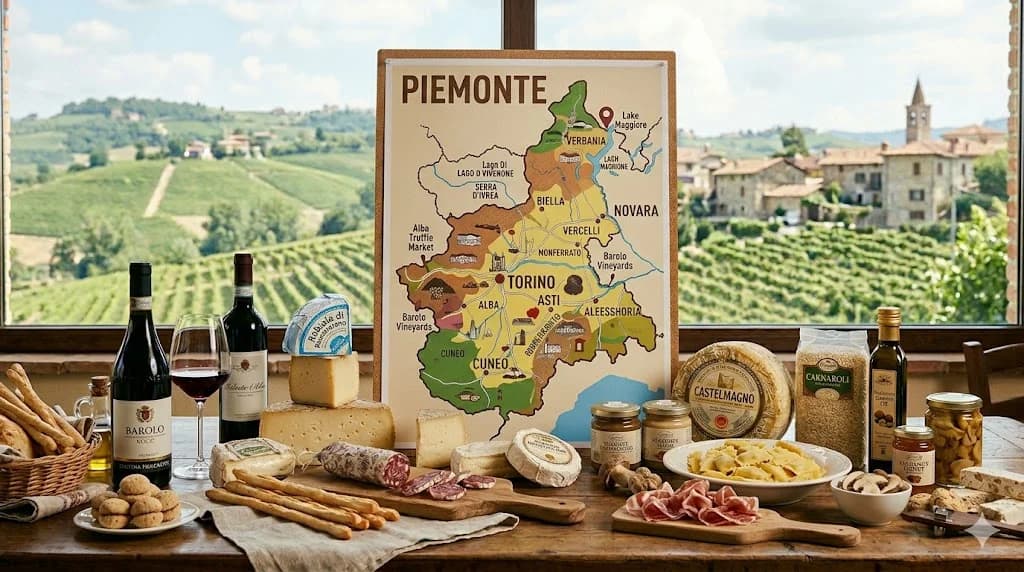
Piedmont
Piedmont: the great region of taste between the Alps, hills and Savoyard tradition
Introduction: Piedmont as gastronomic culture before it is a region
Piedmont is not merely an Italian region: it is a complex gastronomic system, stratified over centuries and built on a rare balance between mountain, hill and plain. Here cuisine never arises by chance, but as a direct response to territory, climate and the social history of its communities.
Among the Alps that safeguard Alpine pasture cheeses, the hills of Langhe and Monferrato dotted with vineyards, and the rice-growing plain of Vercellese, Piedmont has developed one of Italy's most recognizable gastronomic identities. A cuisine that can be at once peasant and aristocratic, rustic and profoundly technical.
Piedmont cuisine: balance between poverty, court and territory
Traditional Piedmont cuisine is defined through one key word: balance. There is no excess, but stratification. There is no uniformity, but adaptation to micro-territories.
Its historical roots
Three souls have built Piedmont gastronomy:
peasant culture, based on preservation and substance
Alpine tradition, linked to milk, butter and extreme seasonality
the Savoyard court, which introduced refined techniques and French influences
From this meeting is born a unique cuisine in the Italian landscape, where raw ingredients are always the protagonist.
Typical products of Piedmont: an extraordinary gastronomic biodiversity
Piedmont is among the Italian regions with the highest concentration of certified excellence. But more than recognitions, what matters is the profound bond between product and territory.
Cheeses: the voice of the Alps and valleys
Piedmont cheeses tell the story of mountains and patience:
Castelmagno DOP, among the most complex and identity-defining Italian cheeses
Toma Piemontese DOP, a widespread symbol of Alpine tradition
Raschera DOP, balance between sweetness and aromaticity
Bra DOP, linked to Cuneo cheesemaking culture
Robiola di Roccaverano DOP, elegant expression of Langhe
Meat, rice and plain products
The plain introduces a more essential but technically refined cuisine:
Vitellone Piemontese della Coscia DOP, absolute reference for Italian beef
Riso di Baraggia Biellese e Vercellese DOP, foundation of Italian rice-growing culture
Symbolic and identity-defining excellences
Some products have transcended the concept of "typicality" to become icons:
White truffle of Alba, natural rarity and worldwide symbol of Piedmont
Nocciola Piemonte IGP, heart of regional pastry-making
Marrone della Valle di Susa IGP
Vermouth di Torino IGP, origin of modern aperitif culture
Gianduiotto, historical synthesis between cocoa and local hazelnut
Traditional Piedmont dishes: the memory of home cooking
Piedmont cuisine is a cuisine of slow gestures, often born in homes before restaurants. Many dishes have become iconic without losing their domestic origins.
Bagna cauda, collective ritual that unites conviviality and territory
Vitello tonnato, perfect balance between delicacy and intensity
Agnolotti del plin, micro-synthesis of Langhe cuisine
Tajarin al ragù, egg pasta that tells the story of refined peasant tradition
Brasato al Barolo, emblem of the meeting between cuisine and great wine
Fritto misto alla piemontese, historical complexity between sweet and savory
Finanziera, memory of aristocratic recovery cuisine
Gnocchi al Castelmagno, direct meeting between pasta and Alpine territory
Bonet, ancient dessert that closes the meal with identity
The great wines of Piedmont: structure, elegance and identity
Piedmont is one of the few regions in the world where wine does not accompany cuisine, but defines it.
The symbolic denominations
Barolo DOCG, absolute synthesis of Langhe
Barbaresco DOCG, elegance and tannin finesse
Barbera d'Asti DOCG, everyday wine of great depth
Dolcetto d'Alba DOC, immediate territorial expression
Moscato d'Asti DOCG, aromaticity and lightness
Gavi DOCG, white expression of the plain
Asti Spumante DOCG, historical identity of Italian sparkling wines
Alongside wines, Vermouth di Torino IGP represents a fundamental chapter in international gastronomic culture, a bridge between wine and mixology.
The great gastronomic areas of Piedmont
Piedmont is not uniform: it is a map of micro-cuisines.
Langhe: territory of white truffle, great reds and the most identity-defining cuisine
Monferrato: balance between rurality and wine-growing tradition
Roero: orchards, hazelnut groves and aromatic wines
Vercellese and Novarese: historic heart of European rice cultivation
Piedmont Alps: culture of milk, cheeses and preservation
Turin and Savoyard area: city of chocolate, vermouth and court cuisine
Gastronomic traditions and events: Piedmont as ritual of taste
In Piedmont food is not merely consumption, but collective ritual and territorial identity.
International White Truffle Fair of Alba
Cheese a Bra, European reference point for raw milk cheeses
Cioccolatò in Turin, celebration of cocoa culture
Bagna Cauda Day, shared ritual that crosses the territory
Hazelnut festivals in Langhe and Roero
Wine fairs across Langhe, Monferrato and Roero
Curiosities: gastronomic Piedmont beyond the table
Gianduiotto was born from a historical necessity: the scarcity of cocoa during the Napoleonic period
Vermouth di Torino is one of the foundations of worldwide aperitif culture
Many iconic Piedmont dishes are born as recovery cuisine and become haute cuisine
White truffle of Alba is one of the rarest and most unpredictable natural products in the world
Piedmont cuisine is among the most influenced by French culture in Italy
How to read and taste gastronomic Piedmont
Understanding Piedmont means accepting the rhythm of its territory. There is not one Piedmont cuisine, but a geography of taste.
To truly appreciate it:
follow the seasonal calendar rigorously
pair wines with the structures of dishes, not just taste
visit production zones to understand the product-territory link
choose authentic local cuisines, where tradition is still daily practice
observe the landscape: in Piedmont taste always arises first in the land rather than on the plate
Conclusion: Piedmont as a model of Italian gastronomy
Piedmont represents one of the most accomplished forms of Italian gastronomic culture. Not because it is simply rich in products or recipes, but because it has built a coherent system in which territory, history and technique coexist without fractures.
It is a cuisine that does not seek effects, but depth. And for this very reason it continues to be one of the most influential and recognizable in the world.