
Abruzzo
Abruzzo: the cuisine of transhumance between the mountains, the silence of the Apennines and the Adriatic
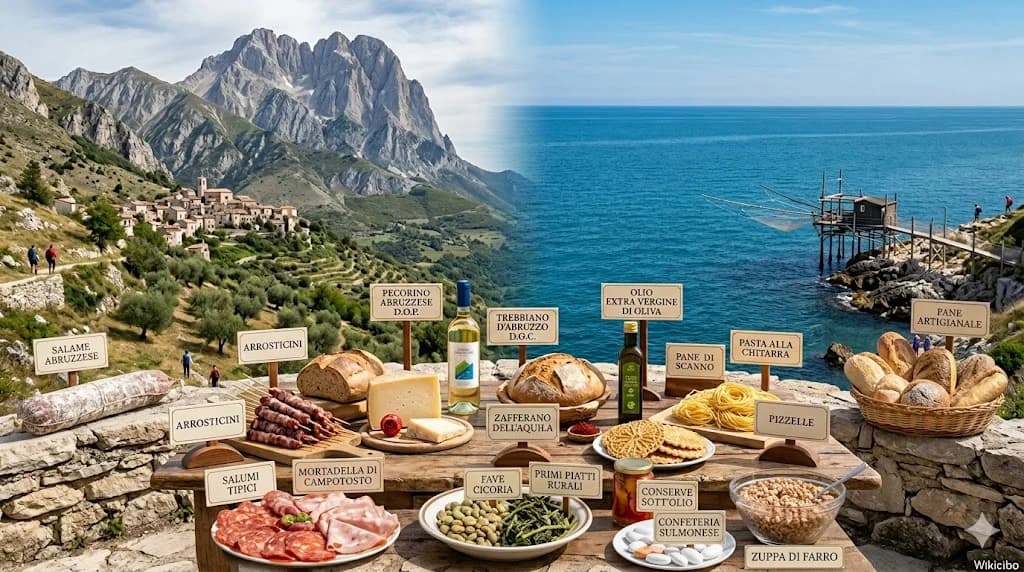
Abruzzo is one of those Italian regions where the cuisine never separates from the landscape. There is no real distance between what you eat and what you experience: the Gran Sasso mountains, the transhumance resorts and the Adriatic Sea are not simple scenarios, but structures that have built a precise, essential and deeply coherent gastronomic identity.
Here, food is not born to be told. It was born to be necessary.
The two symbolic polarities remain L'Aquila, a mountainous and pastoral heart, and Pescara, a contemporary port on the Adriatic coast. Between these two extremes, one of the most recognizable and authentic regional cuisines in Italy develops.
Abruzzo cuisine as a geography of movement
The key to understanding Abruzzo is transhumance: the seasonal movement of flocks along the tractors that cross the Apennines.
This movement has not only shaped pastoral economics, but has defined a true gastronomic grammar based on three principles:
what is produced must withstand time and travel
what you cook must be essential and nutritious
what is preserved becomes identity
The CUC abruzzo is therefore not a set of recipes, but an adaptation system.
Two Abruzzi that are not opposed, but complete each other
Abruzzo is a region that lives in balance.
The Inner Apennines is the world of sheep meat, cheeses and pastoral cuisine
The Adriatic coast is the world of fish, broth and seafood
There is no clear separation, but a continuity of method: the ingredients change, the logic does not change.
Essential ingredients: a kitchen without excesses
Abruzzo cuisine is recognized for its structural essentiality:< /p>
sheepmeat and lamb
durum wheat and egg pasta
local pecorini
extra virgin olive oil
legumes and spontaneous vegetables
oily fish and Adriatic soups
<
li>
saffron and dried sweet pepper
It is a cuisine that builds flavour without accumulation.
The products: identity that comes from the earth
Pastoral culture
Pecorino d 'Abruzzo
Sheep cheese with a strong, expressive taste
of direct Apennine pastoralism.
Pecorino di Farindola
An Italian unicum: produced with pork rennet, testimony to an ancient and isolated dairy tradition.
Abruzzo Ventricina
Teramano spicy sausage, born from the culture of domestic preservation.
The Earth as Intensity
Saffron of the Eagle PDO
Grown in the Navelli plateau, it is one of the most valuable saffrons in the world, the result of manual and fragmented cultivation.
Sweet Altino pepper
Dried and turned into powder or preserved, it represents the peasant wisdom of conservation.
Dishes as a collective memory
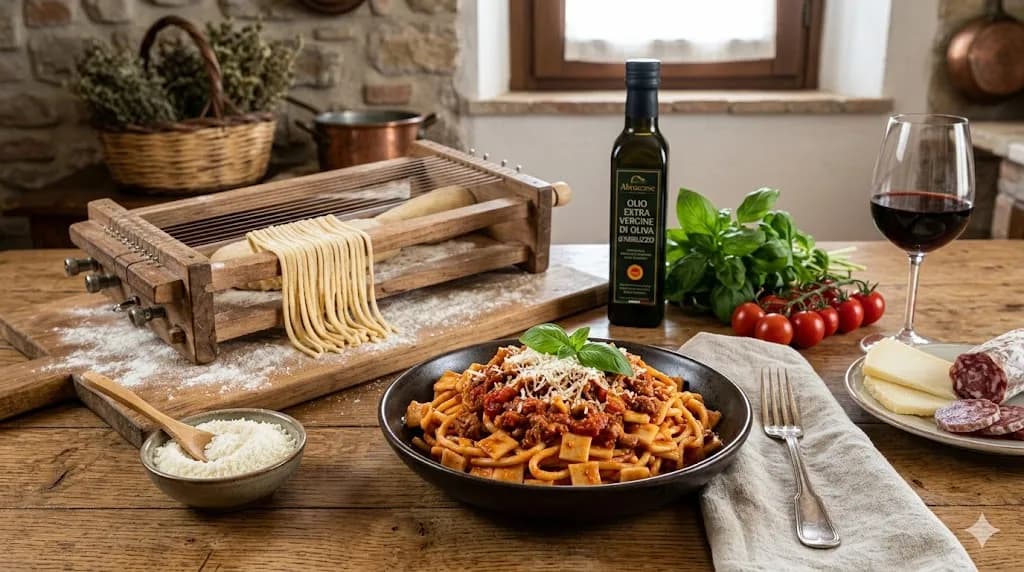
Maccheroni on guitar: the structure of the gesture
Maccheroni on the guitar
It is not just a paste, but a technical gesture handed down: the dough is cut on a stringed instrument that transforms the manual movement into shape.
It is the domestic kitchen that becomes architecture.
Scrippelle ‘mbusse: la se multiplicity as a language
Scrippelle 'mbusse
Very thin crepes dipped in hot broth.
There is no reduction: there is a balance between gesture and substance.
Arrosticini: the kitchen of fire
Arrosticini Arrosticini
are not a recipe, but a cultural form.
Born from the need of shepherds to use simple cuts of sheep meat, they tell of a direct, immediate kitchen, built on live fire.
They are perhaps the most recognizable expression of contemporary Abruzzo.
Cacio e ovo lamb: the kitchen of the return
Cacio e ovo lamb
A dish that synthesises shepherd culture
ale: sheep meat, eggs and pecorino cheese merge in a dense and rural structure.
The sea as continuity, not alternative
Brodetto alla vastese
In the coast of Vasto, brodetto is not a unique soup, but a family of local interpretations.
Each port has its own version, but the logic remains unchanged: fish, time, simplicity.
Wines: structure and identity
Montepulciano d 'Abruzzo Doc
Identity red wine of the region, powerful but gastronomic, built to accompany meat cuisine.
Trebbiano d 'Abruzzo Doc
Bianco essential and daily, historicamen
tied to the domestic kitchen.
Cerasuolo d 'Abruzzo Doc
Rosé structured and deep, rare for its chromatic and gastronomic intensity.
The three geographies of taste
Mountain
Pastoralism, saffron, cheeses, sheep meat.
Hill
Domestic cuisine, pasta, cured meats, oil.
Coast
Fish, broth, essential Adriatic cuisine.
They are not three different cuisines: they are three variations of the same identity.
Traditions: food as communal time or
Abruzzo cuisine does not live only in dishes, but in collective moments:
transhumance as a historical rite
the fests of the arrosticini in the interior areas
the collection of Saffron of the Eagle PDO in the Navelli plateau
the Montepulciano d 'Abruzzo Doc wine festivals
the fish festivals along the Adriatic coast
Food is not consumption: it is a social calendar.
How to really read gastronomic Abruzzo
Abruzzo is not interpreted through excess, but through consistency.
the mountain preserves
the coast simplifies
tradition unites
It is a kitchen that has never needed to be reinvented, because it has never been interrupted.
Conclusion: Abruzzo as a form of gastronomic truth mica
Abruzzo cuisine is one of the clearest representations of original Italian cuisine: not spectacular, but necessary; not built, but naturally evolved.
From arrosticini to brodetto alla vastese, from Zafferano dell 'Aquila PDO to Montepulciano d 'Abruzzo Doc, Abruzzo tells a simple and radical truth: the most authentic cuisine is not born to be told but to be lived every day.