
Guide·Sagre·Fiere·Mercati·Degustazioni
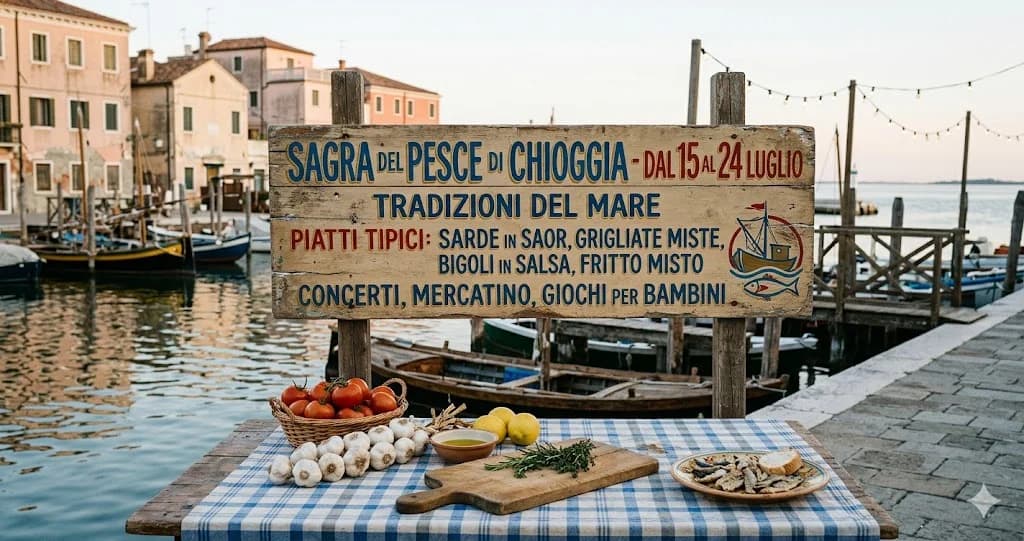
Veneto is a region that has never stopped surprising those who traverse it with care: just a few kilometers apart, the Adriatic Sea and the great pre-alpine lakes create profoundly different gastronomic ecosystems, yet both rooted in the same logic of respect for what the water returns. Along the Venetian and Chioggia coast, fish is worked with ancient frankness, without frills. On Lakes Garda and Santa Croce, trout, carpione and lavarello set the rhythms of lake cuisine. This guide traverses both worlds, season by season, to help the reader navigate among products, markets and the right moments.
The Venetian coast extends for over 160 kilometers, from the Po Delta to the border with Friuli Venezia Giulia, embracing lagoon environments, fishing valleys and sandy shores. Venice, Chioggia and Caorle are the historic centers of a fishing activity that has shaped not only local cuisine, but also the economy and civic identity of entire communities. The lagoon of Venice in particular is a controlled ecosystem, where vongole veraci (Manila clams), canestrelli (scallops), moeche (soft-shell crabs) and granseole (spider crabs) follow precise biological cycles that fishermen have known for generations.
At a short distance as the crow flies, but in a radically different context, Lake Garda represents the great lake basin of reference for western Veneto. The waters of Garda are home to the carpione (endemic fish), an increasingly rare protected species, together with the coregone and the eel. Further north, Lake Santa Croce and Lake Corlo complete a mountain fish landscape that feeds trattorias and mountain huts with a lesser-known but equally solid tradition. Understanding the differences between these two worlds, coastal and lacustrine, is the first step to eating well in Veneto.
January The compact cold of the Adriatic winter favors cuttlefish, which during this period move closer to the coast, and crustaceans like schie, the grey lagoon shrimp typical of Venetian cuisine. On the lakes, lavarello reaches a particularly firm meat consistency.
February Still a winter month, suitable for enjoying mantecato baccalà in its most traditional versions. In the lagoon, seed clams are worked for the repopulation of clam beds. On Lake Garda, fishing nets become more active again after winter's deep pause.
March The arrival of early spring brings the first canestrelli and the last good-sized cuttlefish. On Lake Garda, the carpione season begins, a fish that Garda fishermen treat with salt and vinegar according to a technique that has remained almost unchanged over the centuries.
April The collection of Manila clams resumes with force in the lagoon. Along the coast, the first rock red mullet appear. Lakeside trattorias begin serving coregone in carpione, a dish that plays on the homonymy with the fish but has roots in the preservation technique with vinegar and onion.
May A crucial month for moeche, green crabs in molting phase. The harvesting window lasts only a few weeks and Venetian moecaroli work tirelessly. On Lake Garda, lake trout is in its full season.
June Granseole, the large spider crabs of the northern Adriatic, return to the markets of Chioggia and Rialto. The favorable period for eels from the fishing valleys of the Po Delta also begins.
July and August Summer brings tourism and with it growing demand for mixed fries. It is the season for sardoni in saor, a humble dish that combines sardines marinated in vinegar, onions, raisins and pine nuts. On the lakes, there is the period of least fishing for prized species.
September The month of revival. Cooling temperatures reactivate the movements of coastal fish. Young cuttlefish and the first autumn moeche return. On Lake Garda markets, eels and dried lavarello reappear.
October Second season of moeche, considered by many fishermen superior to the spring season. In the lagoon, work is intense before the winter slowdown. Along the Adriatic coast, Scardovari mussels reach optimal maturation.
November Month of Scardovari DOP mussels and large lagoon sea bass. On Lake Garda, pike fishing begins, an ingredient for ragù and terrines in trattorias on the Venetian shore.
December The holidays bring eel to the table in all its forms, from boiling to roasting, following a ritual calendar that in the Po Delta has medieval roots. In the lagoon, the last granseole can still be found before the winter rest.
Traveling through Veneto by its waters means accepting a slower pace. The rhythm is set by the seasons, the tides, the molting of a crab. Those who arrive in the lagoon looking for moeche in July return disappointed; those who instead organize their trip around the right window find one of the rarest and most iconic products of Adriatic cuisine. The same goes for the carpione del Garda or the eel of the Delta: these are experiences that require planning, but they reward you with something difficult to find elsewhere. The coast and lakes of Veneto are not visited, they are frequented.