
Guide·Sagre·Fiere·Mercati·Degustazioni
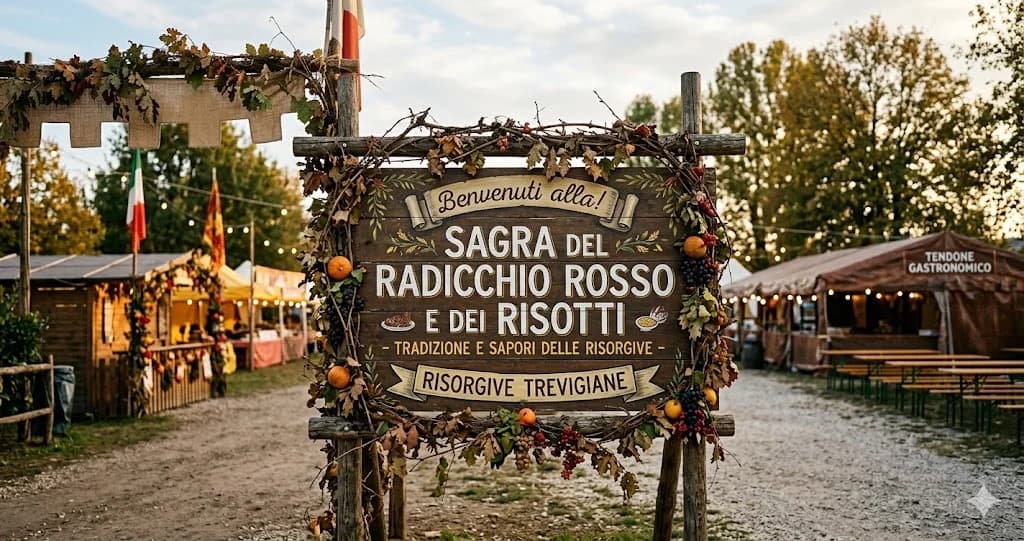
Among the ordered fields of the lower Venetian plain and the rows of poplars that line the springs, every summer and autumn the calendar fills with festivals that resemble no other gastronomic event in the region. Here, far from the Dolomites and art cities, cuisine tells the story of a landscape made of emerging waters, corn, frogs, eels, beans and local rices cultivated on lands that drink from within. This guide accompanies the reader along the main festivals of the plain and springs of Veneto: when to go, what to expect, how to navigate between authentic tradition and superficial folklore.
The Veneto plain is not a homogeneous territory. Between the foothills and the Po delta, zones with very distinct characteristics alternate: the great springs of the Treviso and Vicenza areas, where underground waters surface constantly and fresh even in summer, the lower Padua region with its reclaimed valleys, the Polesine marked by the Po and Adige floodplains. Each microterritory has produced its own cuisine, and the sagre are its public form, the moment in which the community declares its identity through food.
The sagre of this area revolve around a few symbolic ingredients, many of which are protected or being rediscovered: rice of local varieties cultivated in the Verona and Vicenza areas, frogs caught in the ditches of the springs, eel from the delta, fagiolo di Lamon (which has its center in the Belluno area but descends into the plain through the paths of the alpine pastures), polenta di mais marano, baccalà alla vicentina. Alongside the products, the formats matter: the large communal pan, the wood fire, the figure of the volunteer cook as custodian of a collective recipe. The most rooted sagre, some with decades of history, maintain this artisanal structure even when the numbers of visitors have grown.
Spring (April-May) The opening of the festival season in the plain coincides with the appearance of the first frogs in the ditches and with celebrations linked to wild herbs, such as bruscandolo (wild hop) and dandelion. Some minor spring festivals in the Padua and Treviso areas offer risottos with spring water herbs and country-style frittatas. The number of participants is limited, and the atmosphere is intimate.
June The season of freshwater fish festivals begins. In the Vicenza and Treviso areas, the first celebrations dedicated to tench and pike appear. The climate still allows for comfortable evenings, and many events take place outdoors along the banks of the spring-fed canal systems.
July Peak month for fried frog festivals, concentrated especially in the lower Treviso plain and the eastern strip of the Vicenza area. Evenings extend late into the night; the gastronomic offering often expands to include polenta, risotto, and bigoli in salsa.
August Polesine enters into full swing with eel festivals, some of which take place in riverside villages along the Po di Levante and Po di Maistra. At the same time, in the lower Verona area, celebrations linked to local rice are held. It is the month with the largest number of events running simultaneously.
September The harvest sets the rhythm for plain festivals as well. Pairings appear between local wines, often Tai rosso or Raboso, and late summer dishes. Festivals dedicated to borlotto beans begin this month in the hilly and piedmont transition zones.
October Month of full gastronomic autumn: polenta festivals, salt cod (especially in the Vicenza area), Chioggia and Castelfranco radicchio, and the last freshwater fish celebrations before the cold arrives. Favorable temperatures still allow for outdoor evening events.
November-March Almost total pause in outdoor festivals. Some parishes and associations keep traditions alive with indoor dinners, especially linked to chestnuts, pork, and soppressa.
The Veneto plain does not offer itself immediately. It requires a certain willingness to stop, to sit on a wooden bench under a canvas tent, to wait for the risotto to be ready. The festivals of this territory are not spectacle, they are an exercise in community. They bring to the surface a cuisine that would otherwise remain closed in homes, in handwritten recipe books, in the memories of those who watched their grandmothers cook. It is worth seeking them out even when they are small, even when they do not appear in guides, even when the program includes only one dish and an accordion. Often it is precisely there that one finds something genuine.