
Guide·Sagre·Fiere·Mercati·Degustazioni
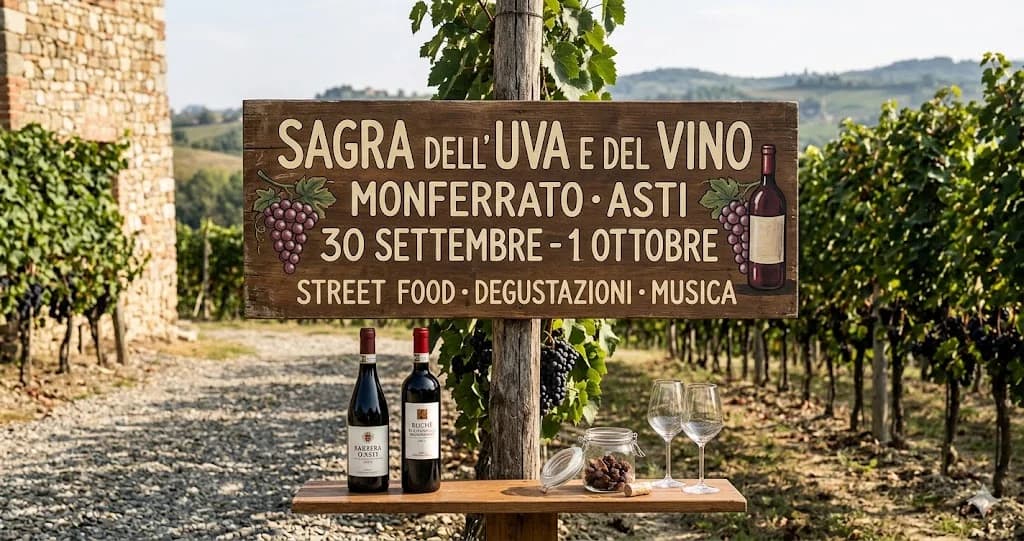
Monferrato is not simply a wine region of Piedmont: it is a landscape that is eaten and drunk, where hills designed by rows of Barbera and Grignolino vines tell a centuries-old agrarian story. Among the vineyards and oak woods hide truffles, farmhouse cheeses, cured meats aged in cellars and pasta pulled by hand on wooden tables worn smooth by use. This guide accompanies the reader through the seasons, the market squares, the cellars and trattorias of a land that has built its own gastronomic identity without ever chasing trends, remaining faithful to a precise and recognizable repertoire.
Monferrato occupies the heart of the province of Asti and part of the province of Alessandria, extending between the Po and the Ligurian Apennines in a succession of gentle hills in the Lower Monferrato and steeper ones in the Casalese area. It is a border land: culturally Piedmontese, but open to Ligurian and Lombard influences, which has produced a cuisine capable of working with essential ingredients while delivering dishes of great complexity.
The vine is the dominant crop, with denominations such as Barbera d'Asti DOCG, Grignolino d'Asti DOC, Ruché di Castagnole Monferrato DOCG and Moscato d'Asti DOCG that define not only the wine but the entire economy of the territory. Alongside the vineyard, the tonda gentile hazelnut, the white truffle from the Moncalvo area, Piedmontese breed cattle raised in the farmhouses of the plain and raw milk cheeses from the border Langhe compose an articulated pantry. Those who travel through Monferrato with care discover that every village guards at least one local specialty difficult to find elsewhere: the caplèt di Montemagno, the salame d'la duja preserved in lard, the Robiola di Roccaverano DOP that descends toward the Ligurian border.
January and February The coldest months mark the time of aged cured meats and slow-braised dishes. In the farmhouses, the cycle of domestic pork butchery opens: salame d'la duja, sausages preserved in lard, aromatic lardo. In the cellar, Barbera begins its aging. It is the best time to order a finanziera or a bollito misto with traditional sauces in the trattorias of Basso Monferrato.
March and April With the thaw come wild herbs: nettles, dandelion, silene, borage. Traditional housewives use them in risottos, omelets, or as filling for ravioli. The vines awaken and in the villages the first fairs dedicated to young Grignolino are organized, a fragile and nervous wine that is drunk chilled and with light meats.
May and June The season of wild asparagus and the first hill strawberries. The markets of Asti and Casale Monferrato fill with early produce. The producers of Ruché di Castagnole Monferrato open their cellars to the public during spring festivals. It is the ideal time to visit mixed agricultural farms that combine vineyard and orchard.
July and August Summer brings Carmagnola peppers, eggplants and cuore di bue tomatoes that in Monferrato become ingredients of summer bagna càuda prepared out of season with fresh vegetables. Festivals multiply in the villages: from the Grignolino Festival in Vignale Monferrato to patron saint celebrations with Piemontese beef grilling.
September and October The harvest is the densest moment of the year. The air smells of must in the streets of the villages. At the same time, in the woods of Casalese and around Moncalvo, the hunt for white truffle begins: the trifolau go out at dawn with their dogs and the Moncalvo market becomes a reference point for enthusiasts and restaurateurs. Late harvest Moscato d'Asti is picked in October.
November and December It is the time of roasted hazelnuts and gianduia chocolate that has in Monferrato one of its preferred territories. Chestnut festivals enliven the hillside villages. At table return the great winter dishes: chickpea soup, fritto misto alla piemontese with semolina dessert, fonduta in its local versions. The Christmas markets of Asti offer artisanal nougat and hazelnut biscuits.
Monferrato rewards those who slow down. It is not a territory that reveals itself in a weekend of racing between famous wineries and starred restaurants: it is better understood by stopping at a country osteria for lunch, asking the producer why he chose not to vinify in wood, following a trifolau among the oak trees of the Casalese at the dawn of October. The complexity of this land lies in the minor details, in the coherence between landscape, vineyard and cuisine that was not built to please visitors but was formed over time to respond to real needs. It is worth meeting it with the same slowness with which it was born.